Wedding Season Salon Marketing: How to Fill Your Calendar Without Losing Control
Wedding season can be one of the biggest opportunities for an Indian salon — if you manage enquiries, bookings and follow-ups without losing control.
Someone who normally visits a salon every few months may suddenly need several services within a short period. A bride may need multiple appointments. Her family members may need grooming. Friends may book makeup, hair, nails or other services. Guests attending wedding functions may also start looking for appointments. Then there are engagement ceremonies, haldi, mehendi, sangeet, receptions and pre-wedding events. For a salon in Delhi NCR, Gurgaon, Noida, Ghaziabad or another major city, wedding season can bring a significant increase in enquiries. But there is a problem. More enquiries do not automatically mean more revenue. A salon can receive hundreds of enquiries and still lose business because nobody followed up properly. Customers can ask for prices and disappear. Someone can call while the front desk is busy and never receive a callback. A bride can ask for available dates but never get a structured follow-up. An existing customer may book once but never be contacted again. And when the calendar becomes crowded, the owner can lose visibility over staff, services, appointments and customer history. Wedding season therefore needs more than a marketing campaign. It needs acustomer journey.
Customers start planning before they actually book
A common mistake is assuming that a customer who searches for a salon today wants an appointment today. That is not always the case. Someone may be: Comparing salons Checking prices Asking about availability Looking for bridal packages Checking reviews Discussing options with family Waiting for a wedding date to be confirmed Planning services for multiple family members This means an enquiry should not be treated as a lost customer simply because they did not book immediately. The salon needs a way to keep track of the enquiry. For example: Day 1:Customer asks about bridal services. Day 2:Salon follows up. Day 5:Customer receives relevant information. Later:Customer confirms the wedding date. Next:Appointment or consultation is scheduled. Without a system, these conversations can easily get lost in phone calls, WhatsApp chats and notebooks. A CRM helps create a record of the customer and the conversation or enquiry journey so the salon can follow up more consistently.
Explore related Swalook features
Wedding customers are not all the same
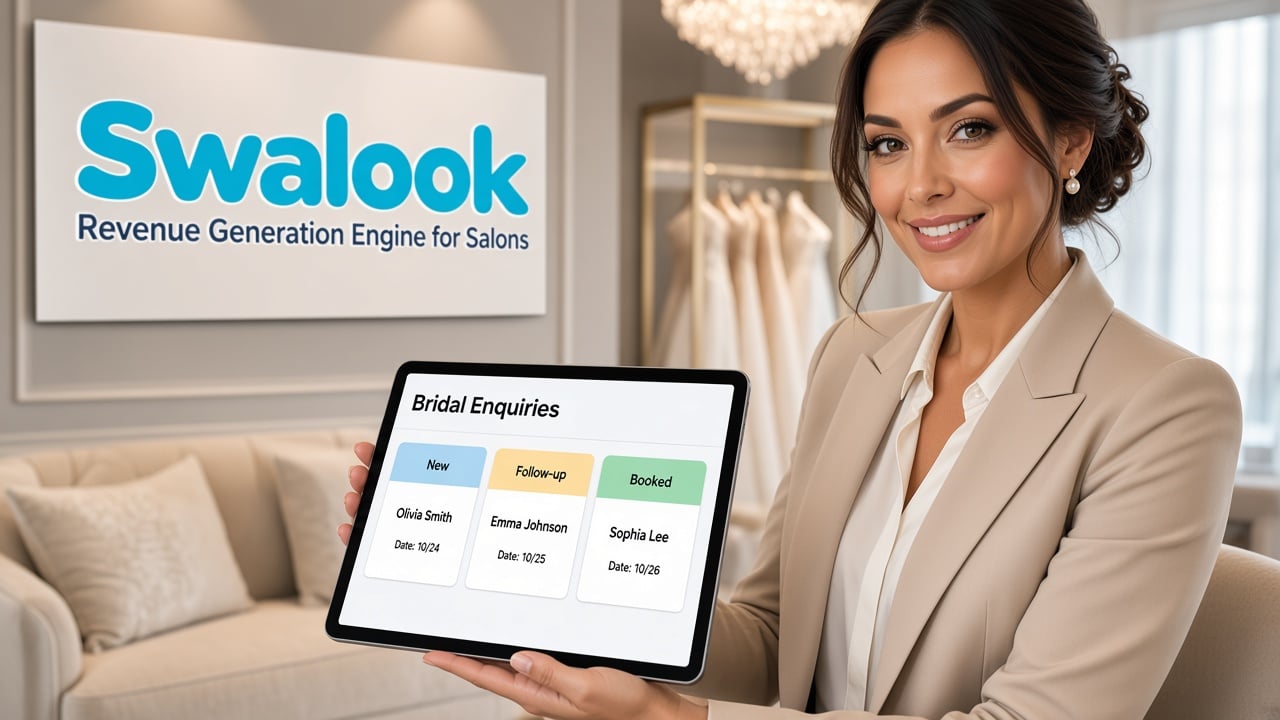
This is another reason generic salon marketing does not work particularly well during wedding season. A bride has different needs from a wedding guest. A groom may have different requirements from the bride’s mother. A customer looking for one haircut should not necessarily receive the same communication as someone planning several appointments. A salon should therefore think in terms of customer groups. For example: Bridal enquiries These may require more detailed consultation, multiple services and advance planning. Family enquiries These may involve several customers and appointments. Wedding guests These may need grooming, hair, beauty or styling shortly before the event. Existing salon customers They may already trust the salon and simply need to be reminded to book. New customers They may need reassurance, information and a reason to choose your salon. A CRM makes this type of customer segmentation easier to manage.
Your existing customers can be your easiest wedding-season opportunity
A salon does not always need to find completely new customers. Look at the people who already know your salon. Suppose someone regularly gets their hair done at your salon. They may have a wedding coming up. But if the salon does not know about it, there is no reason for the owner or staff to contact them. This is where customer history becomes useful. The salon can identify customers who: Visit regularly Have previously purchased relevant services Have not visited recently Have upcoming service needs Have higher customer value Have previously responded to salon communication Instead of starting every marketing campaign from zero, the salon can use existing customer relationships. That can make the marketing more relevant.
Do not make every wedding-season message a discount Discounting is easy. It is also easy to become dependent on it. A salon can start a wedding campaign by offering a discount. Then another salon offers a larger discount. Then another salon offers a package. Eventually, customers start comparing only prices. A stronger approach is to communicate the value of planning. For example: “Wedding date confirmed? Plan your salon appointments early.” Or: “Need appointments for multiple family members? Let us help you plan them together.” Or: “Your wedding preparation should not depend on finding a last-minute slot.” These messages address an actual problem. Wedding customers are often dealing with deadlines. Their appointment has to happen before a specific event. That makes convenience and availability valuable.
Your salon’s calendar becomes a sales asset
During wedding season, your calendar is not just an administrative tool. It determines how much work your salon can actually handle. Suppose you receive 20 enquiries for a particular Saturday. You cannot accept all 20 if the required staff and service capacity are not available. The question then becomes: Which customers can be scheduled? Which services require the most time? Which employees can handle them? Which appointments should happen earlier? Can another day be offered? A proper appointment system makes these decisions easier. The owner can see availability instead of guessing. The front desk can respond faster. Customers can get realistic appointment options. And the salon can reduce the chances of overbooking.
Fast follow-up matters Imagine a customer sends a WhatsApp message: “Hi, I need bridal makeup and hair. Wedding is on 18 December. Please share details.” The salon replies three hours later. By then, the customer may already have contacted three other salons. The problem is not necessarily the quality of your service. It is the speed and consistency of communication. This is why lead management and follow-up should be connected. When a new enquiry enters the system, the salon should know: Who is the customer? What are they looking for? When is the wedding? Has anyone responded? Has the customer booked? Does someone need to follow up? Automation can help with routine communication, while staff can step in when a conversation requires personal attention.
This is where Google and Meta become more useful when connected to CRM
Many salon owners think about advertising in terms of leads. For example: “We spent money on Meta and received 50 enquiries.” But what happened to those 50 people? Did they book? Did they visit? How much did they spend? Did they return? Those questions matter. Google and Meta can be excellent sources of customer discovery. But they are not the entire customer journey. The journey continues after the advertisement. A more useful structure is: Google / Meta advertisement ↓ Customer enquiry ↓ CRM record ↓ Follow-up ↓ Appointment ↓ Salon visit ↓ Billing ↓ Future communication This is where Swalook’s acquisition and CRM capabilities can work together. Swalook does not replace Google or Meta. Instead, the goal is to connect customer acquisition with the rest of the salon’s customer journey.
Wedding season is also a test of your front desk
Your front desk may be able to manage 20 enquiries during a normal week. During wedding season, that number can increase quickly. The problem is not always the number of employees. It is the number of disconnected tasks. The front desk may have to: Answer calls Respond to WhatsApp Check appointments Ask staff about availability Give prices Record new customers Confirm bookings Handle cancellations Follow up with old enquiries Manage walk-ins When all of this is handled manually, something will eventually be missed. A connected salon system can reduce the amount of information the front desk has to remember. The system becomes the place where customer and appointment information is recorded.
Keep track of wedding customers after the event
This is one of the biggest missed opportunities in wedding-season marketing. A customer may spend significantly more than normal because they are preparing for a wedding. The salon completes the appointment. The customer leaves. Then nothing happens. Why? Because everyone is busy finding the next customer. But the wedding customer is now a known customer. The salon knows: What service they purchased When they visited Potentially what other services they use Their contact information Their appointment history That creates an opportunity for future communication. For example, a customer who booked services for a wedding may later need: Regular hair services Hair maintenance Skin services Grooming Party preparation Hair colour maintenance Membership Loyalty benefits The first wedding appointment can therefore become the beginning of a longer relationship.
Membership can be useful after high-value occasions
A customer who has already experienced your salon may be more receptive to a membership or loyalty program than someone who has never visited. The important thing is timing. Do not immediately push a membership before the customer has experienced the salon. Instead, after a successful service, the salon can introduce relevant membership or loyalty options. This is particularly useful for customers who have recurring needs. For example, a customer who regularly needs hair services may benefit from a structured membership. The salon benefits from creating a reason for the customer to return. Swalook includes salon membership and loyalty capabilities that can be used as part of this broader retention strategy.
Do not let wedding season create operational problems
More customers can expose weaknesses in the business. For example: Staff availability If a particular service depends heavily on one employee, what happens when that person is unavailable? Inventory If a high-demand service requires a particular product, is enough stock available? Appointments Are services being scheduled realistically? Billing Are all services being billed correctly? Customer history Can staff quickly understand what the customer has taken previously? Follow-up Who is responsible for contacting enquiries that did not book? These are not separate problems. They are connected. That is why a salon management platform should ideally connect customer management with daily operations.
How Swalook can help during wedding season
Swalook’s CRM can keep customer information, appointment history, services and billing-related customer information together. That gives the salon a clearer picture of the customer. Its inquiry management capabilities can help the salon organize incoming enquiries instead of relying entirely on memory or scattered conversations. Appointments can be managed through the salon’s booking workflow. WhatsApp automation can support structured customer communication and follow-ups according to the salon’s configured workflow. Customer acquisition capabilities can connect the marketing side with the customer journey. Membership and loyalty features can support longer-term customer relationships. Analytics can then help the owner review what happened rather than relying only on the total billing number. The value is not one individual feature. It is the connection between them.
A practical wedding-season workflow
A salon could structure its wedding-season process like this: Step 1: Generate awareness Use Google, Meta, Instagram and existing customer communication to reach potential customers. Step 2: Capture enquiries Every meaningful enquiry should become part of the salon’s customer or lead record. Step 3: Follow up Customers who do not book immediately should not disappear. Step 4: Book Offer suitable appointment slots based on actual availability. Step 5: Prepare Check staff and inventory before the appointment. Step 6: Deliver Provide the service and maintain the customer experience. Step 7: Record Customer history and service information should remain available for future reference. Step 8: Reconnect After the wedding season, communicate with the customer based on their likely future needs. Step 9: Retain Introduce relevant loyalty or membership options where appropriate. Step 10: Analyse Review which channels, services and customer groups contributed to the business.
The goal is not just a full calendar A full calendar looks good. But a salon owner needs to ask a bigger question: What happens after the calendar is full? If the salon cannot manage appointments properly, customers become frustrated. If the team is not prepared, service quality can suffer. If leads are not followed up, advertising money can be wasted. If customer information is not recorded, future opportunities disappear. And if wedding customers are not contacted again, the salon may have to acquire the same customers all over again. The better approach is to treat wedding season as a complete customer journey. Get discovered. Capture the enquiry. Follow up. Book the appointment. Deliver the service. Understand the customer. Stay connected. Bring them back. That is how wedding season can become more than a few busy weeks on the calendar. It can become a source of long-term customers. Related Swalook pages:Salon CRM, Customer Acquisition, Inquiry Management, WhatsApp Marketing, Customer Retention, Salon Membership, Loyalty Program, Appointments, Analytics. Suggested CTA:Book a Demo
Frequently Asked Questions
How can a salon get more customers during wedding season?
A salon can increase wedding-season bookings by planning its campaigns early, targeting the right customer groups, following up with enquiries quickly and making the booking process simple. Existing customer data can also be used to identify customers who may already be preparing for weddings or events.
How early should a salon start wedding-season marketing?
There is no single date that works for every salon or city. However, salons should start before customers are actively looking for last-minute appointments. Early communication gives customers more time to consider services, packages and appointment dates.
How can salons convert wedding enquiries into bookings?
Fast and relevant follow-up is important. Instead of sending the same message to everyone, salons can follow up based on the service the customer asked about, their stage in the booking process and their previous interactions with the salon.
Should salons offer discounts during wedding season?
Not necessarily. Strong demand does not always require heavy discounts. Salons can instead create well-designed packages, bundles, memberships or value-added services that increase the customer's perceived value without unnecessarily reducing the price.
How can a salon know which marketing campaign brought a customer?
A salon needs to connect customer acquisition information with its CRM and booking data. Tracking the source of enquiries and subsequent bookings makes it easier to understand which campaigns are actually generating revenue rather than simply generating clicks or enquiries.
You may also like
Ready to handle festive and wedding rush with Swalook?
See how Swalook helps Indian salons manage customers, bookings, marketing and growth in one place.
Book a Demo